
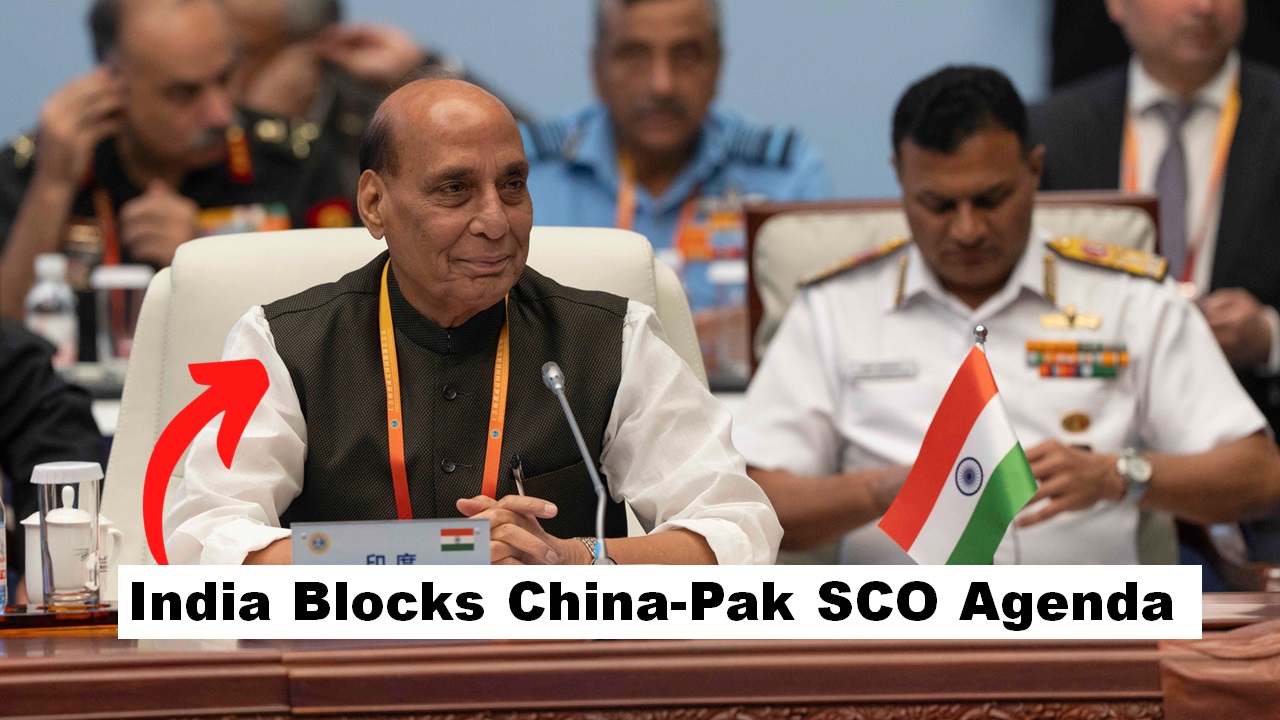
India took a firm and visible stand at the recent Shanghai Cooperation Organisation (SCO) summit, making headlines by refusing to sign a key joint document. Defence Minister Rajnath Singh’s decision to withhold India’s endorsement wasn’t a formality it was a calculated diplomatic move aimed at defending the country’s territorial integrity and asserting its national priorities.
The move signals a more assertive India, one willing to stand alone if necessary when it comes to issues of sovereignty, terrorism, and regional representation.
What Sparked the Refusal SCO ?
At the heart of the issue is a document meant to be endorsed by all member states at the SCO summit. While such documents typically reflect consensus and shared goals, this particular one raised red flags in New Delhi. According to reports, the statement:
- Omitted any reference to Pahalgam, a prominent and symbolic region in Jammu and Kashmir
- Included mentions of Balochistan, aligning with Pakistan’s internal political narrative
- Lacked the strong anti-terrorism language India had proposed, reportedly due to objections from Pakistan
India viewed these omissions and inclusions as subtle but clear attempts to legitimize the strategic narratives of China and Pakistan, while sidelining its own positions. Rajnath Singh, who led the Indian delegation, took up these concerns directly with Chinese Defence Minister Dong Jun in a bilateral meeting held on the sidelines of the summit.
By declining to sign, India sent a message that it will not lend its approval to documents that indirectly validate contested narratives or ignore its core concerns.
India’s Strategic Messaging
India’s refusal to back the document wasn’t just about one paragraph or missing word it was a reflection of a broader strategic posture. Several key takeaways underline this point:
- Assertiveness on Terrorism: India has consistently pushed for strong language and action against cross-border terrorism in multilateral forums. The dilution of this stance in the SCO document, largely due to Pakistani objections, was unacceptable to New Delhi.
- Territorial Integrity: The omission of references to Pahalgam, a region deeply linked to India’s national identity and religious heritage, was seen as a deliberate slight. India has become increasingly sensitive to international documents that may be interpreted as questioning its claims over Jammu and Kashmir.
- China-Pakistan Influence: India’s decision to withhold endorsement highlighted growing discomfort with the increasing sway of the China-Pakistan axis within the SCO. Both countries have sought to use regional groupings to shape narratives around terrorism and sovereignty often at India’s expense.
Even during the bilateral meeting with Dong Jun, Rajnath Singh is said to have reminded China that adding new complexities to the already strained India-China relationship would be counterproductive. He also reportedly raised the issue of Kailash Mansarovar Yatra, a religious pilgrimage route affected by Chinese control in Tibet underscoring that religious sensitivities and border issues remain non-negotiable.
Criticism and Counterpoints
Not everyone viewed India’s move positively. Former diplomat Yashwant Sinha remarked that the episode left India looking “completely isolated” within the SCO. Indeed, when one country withholds consensus, it often raises eyebrows.
But that criticism may oversimplify the issue. India’s stance wasn’t about isolation; it was about principle-based diplomacy. In fact, standing up for national interest, even in the face of disagreement, can often earn a country greater respect in the long run. And in India’s case, this approach aligns with its growing stature on the world stage.
India’s assertiveness on terrorism, for instance, resonates with several global powers, including the United States, France, and Australia countries with which India shares security and strategic cooperation frameworks like the Quad. By refusing to compromise within the SCO, India may in fact be solidifying its credibility among these partners.

What This Means Going Forward
This diplomatic episode could shape how India engages with multilateral groups like the SCO in the future. While India will likely remain a participant, it may:
- Be more selective in supporting consensus-based statements
- Push its anti-terrorism agenda in forums where there’s stronger alignment
- Continue to challenge narratives that undermine its territorial claims
This also feeds into a broader recalibration of India-China relations, especially around contentious issues like the LAC standoff, infrastructure development in border regions, and trade imbalances.
For ordinary citizens, these developments may feel remote but they aren’t. When India refuses to yield on international platforms, it is essentially reinforcing that national interests including territorial integrity, cultural identity, and security are not up for compromise.
Conclusion: A New Diplomatic Tone
India’s refusal to sign the SCO document may seem like a minor detail in a larger summit. But it represents something much bigger: a more confident and uncompromising foreign policy. Whether it’s about pushing back on terrorism, defending Jammu and Kashmir, or challenging China and Pakistan’s narratives, India is no longer content to play along quietly.
In a world where geopolitical alliances are shifting, India is carving out its own path even if it means standing alone.
This isn’t just diplomacy as usual. It’s a glimpse of a new India: strategic, bold, and unapologetically assertive.

You’re a motorcycle nut like me, always on the lookout for the next ride that’s going to make your heart Read more

Toyota has officially pulled the wraps off a new GR86 Special Edition, and it is everything a driving enthusiast could Read more

The Tata Curvv, one of the brand’s most anticipated upcoming SUVs, has been spotted once again during testing. But this Read more

In a major leap for India’s aerospace manufacturing ambitions, Mahindra has signed a landmark deal with Airbus to manufacture helicopter Read more

At AutoTechXpert.in, we're passionate about all things automotive—from the latest car launches and cutting-edge EV tech to in-depth reviews and performance insights. Our editorial team is made up of seasoned auto journalists, tech enthusiasts, and driving purists who live and breathe the road. With years of industry experience, we break down complex car jargon into real, relatable advice to help you make smarter automotive decisions.