
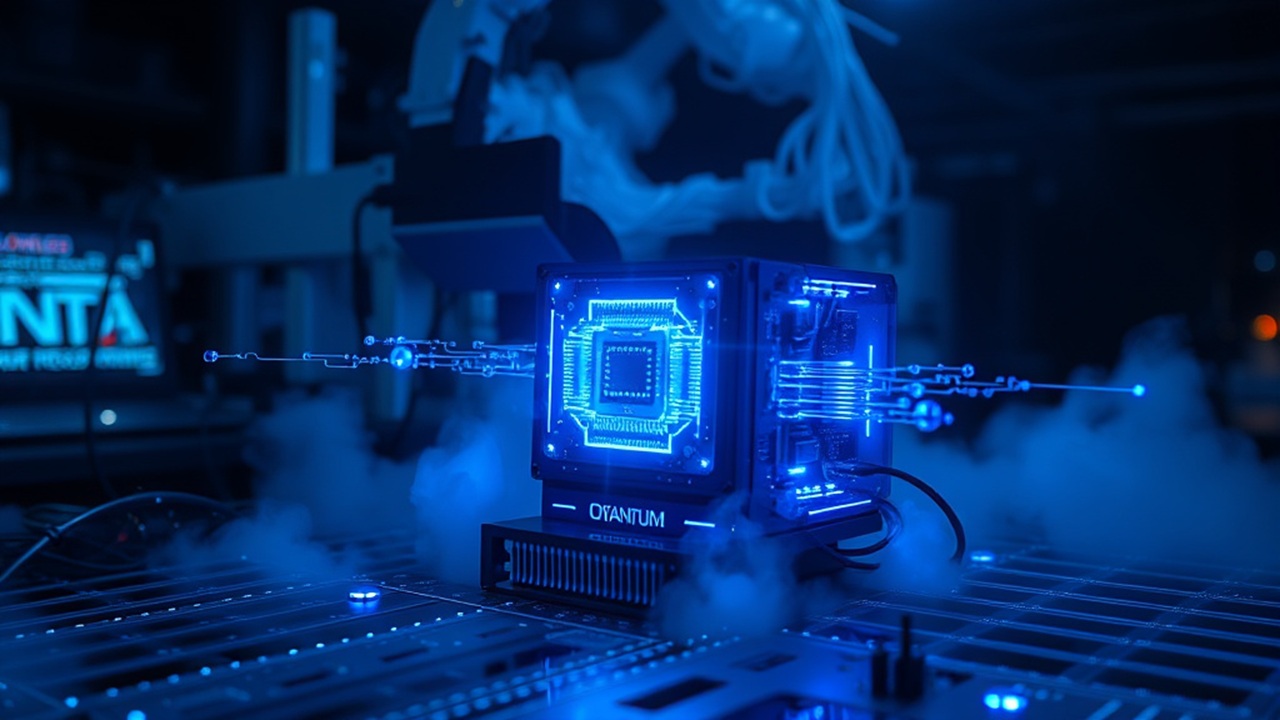
Quantum computing has been “just a few years away” for what feels like decades. Yet, if you look closely at 2026, something feels different this time. The conversation has shifted from theoretical potential to measurable progress. Big tech companies, startups, and research labs are no longer just publishing papers. They are building real machines, testing them in real environments, and quietly solving problems that classical computers struggle with.
Still, it is easy to get lost in hype. Headlines scream about quantum supremacy and revolutionary chips, but what is actually happening behind the scenes? Are we truly on the edge of a computing revolution, or are we still laying the groundwork?
Let’s break it down in simple terms and take an honest look at where quantum computing hardware really stands in 2026.
Understanding the Hardware: What Makes Quantum Computers Different
At the heart of quantum computing is the qubit. Unlike a classical bit, which is either 0 or 1, a qubit can exist in multiple states at once thanks to superposition. Add entanglement into the mix, and you get a system where qubits can influence each other instantly, even across distances.
That sounds powerful, and it is. But it also creates a massive engineering challenge.
Qubits are incredibly fragile. They are sensitive to heat, noise, vibrations, and even cosmic radiation. Maintaining their quantum state requires extreme conditions, often close to absolute zero. This is why many quantum computers look more like science experiments than practical machines, with large cooling systems and complex shielding.
So when we talk about breakthroughs in hardware, we are really talking about progress in stability, scalability, and error correction.
The Race to Build Better Qubits
Different companies are betting on different types of qubits, and in 2026, there is still no clear winner.
Superconducting qubits remain the most widely used. Companies like IBM and Google continue to refine them, increasing qubit counts and improving coherence times. These systems rely on circuits cooled to near absolute zero, and while they have shown strong progress, scaling them remains difficult.
Trapped ion qubits offer a different approach. Instead of circuits, they use charged atoms held in place by electromagnetic fields. These systems are known for their high accuracy and long coherence times, but they are slower and harder to scale.
Photonic qubits, which use particles of light, are gaining attention because they can operate at room temperature. This could remove one of the biggest barriers in quantum hardware. In 2026, companies working on photonics are making steady progress, especially in building more compact and flexible systems.
There are also emerging approaches like topological qubits, which promise better stability by design. Microsoft has been heavily invested in this area. While progress has been slower, any real breakthrough here could change the entire landscape.
What is important to understand is that this diversity is not a weakness. It is a sign that the field is still evolving. Just like early computers experimented with different architectures, quantum computing is still figuring out what works best.
Scaling Up: From Dozens to Thousands of Qubits
One of the biggest milestones in quantum computing is increasing the number of qubits. In the early days, having 10 or 20 qubits was impressive. By 2026, we are seeing systems with hundreds and even over a thousand qubits in experimental setups.
But more qubits do not automatically mean better performance.
The real challenge is maintaining quality as systems grow. Each additional qubit introduces more noise and more potential for errors. This is why researchers often talk about “useful qubits” rather than just raw numbers.
In 2026, the focus has shifted toward improving qubit fidelity and connectivity. Instead of just adding more qubits, companies are working on making them interact more reliably. Modular designs are also becoming popular, where smaller quantum processors are linked together to create larger systems.
This approach mirrors how classical computing evolved, moving from single processors to distributed systems.
Error Correction: The Hidden Breakthrough
If there is one area where real progress is happening, it is quantum error correction.
Quantum systems are inherently noisy. Even the smallest disturbance can cause calculations to fail. To solve this, researchers use multiple physical qubits to create a single logical qubit that is more stable.
In 2026, we are starting to see practical demonstrations of error correction that actually improve performance. This is a big deal because it moves quantum computing from fragile experiments toward reliable systems.
However, error correction comes at a cost. You may need hundreds or even thousands of physical qubits to create a single logical qubit. This means that even a machine with 1000 qubits might only have a handful of usable logical qubits.
It sounds limiting, but it is a necessary step. Think of it like early computers that filled entire rooms but had less power than a modern smartphone. Progress often starts inefficiently before it becomes practical.
Cooling, Control, and Infrastructure Improvements
When people think about quantum breakthroughs, they often imagine futuristic chips. But a lot of progress is happening in the supporting hardware.
Cooling systems are becoming more efficient and compact. Control electronics are improving, allowing for more precise manipulation of qubits. Even the software that interfaces with hardware is getting better, making it easier to run experiments and optimize performance.
In 2026, there is also a growing focus on integrating quantum systems with classical infrastructure. Hybrid computing models are emerging, where classical computers handle most tasks and quantum processors are used for specific calculations.
This hybrid approach is likely to dominate in the near future because it plays to the strengths of both systems.
Are We at Quantum Advantage Yet?
The term “quantum advantage” refers to a point where quantum computers can solve real-world problems better than classical ones.
In 2026, we are not fully there yet, at least not in a broad, practical sense. There have been specific demonstrations where quantum systems outperform classical computers, but these are often narrow and highly controlled scenarios.
However, we are getting closer.
Fields like chemistry, material science, and cryptography are showing early signs of benefit. For example, quantum computers are being used to simulate molecular interactions more accurately than classical models in certain cases.
These are not headline-grabbing applications for everyday users, but they are important stepping stones. They show that quantum computing is moving beyond theory and into practical experimentation.
The Role of Big Tech and Startups
The progress we see in 2026 is not coming from a single source. It is the result of a global effort.
Large companies like IBM, Google, and Microsoft are investing heavily in quantum hardware. They have the resources to build complex systems and push the boundaries of what is possible.
At the same time, startups are bringing fresh ideas and specialized approaches. Many are focusing on niche areas like photonic systems, error correction, or quantum networking.
Governments are also playing a major role, funding research and building national quantum programs. This level of investment is a strong signal that quantum computing is seen as a strategic technology for the future.
The Reality Check: What Quantum Computers Cannot Do Yet
It is important to stay grounded.
Quantum computers in 2026 are not replacing your laptop or running everyday applications. They are not solving all optimization problems instantly or breaking encryption at scale.
Most quantum systems are still experimental. They require specialized environments and are accessible mainly through cloud platforms.
If you are expecting a consumer quantum device anytime soon, that is not realistic. The timeline for mainstream adoption is still measured in years, if not decades.
But that does not mean progress is slow. It means the challenges are deep and require careful engineering.
What the Next Few Years Might Look Like
Looking ahead, the focus will likely remain on three key areas.
First, improving qubit quality and stability. Better qubits mean fewer errors and more reliable computations.
Second, scaling logical qubits through advanced error correction. This is the bridge between experimental systems and practical machines.
Third, developing real-world applications that justify the investment. As more use cases emerge, the pace of development will accelerate.
There is also growing interest in quantum networking, where multiple quantum systems are connected. This could lead to distributed quantum computing, opening up new possibilities.
A Human Perspective: Why This Moment Feels Different
If you have been following quantum computing for a while, you might remember the early excitement that never quite translated into real-world impact.
2026 feels different because the conversation has matured.
Researchers are more cautious with their claims. Companies are focusing on measurable progress rather than flashy announcements. And there is a clearer understanding of the challenges ahead.
It is a bit like watching the early days of the internet. At first, it was slow, limited, and hard to use. But the foundation being built eventually changed everything.
Quantum computing is at a similar stage. It is not ready for everyday use, but the groundwork is becoming solid.
Final Thoughts
So where are we really in 2026?
We are in the transition phase between experimentation and early practicality. The hardware is improving, error correction is becoming viable, and real applications are starting to emerge.
But we are not at the finish line.
Quantum computing is still a work in progress, and the biggest breakthroughs may still be ahead. What matters is that the field is moving forward in a meaningful way.
If you strip away the hype, what remains is something more interesting. A slow, steady build toward a new kind of computing that could eventually reshape industries.
And for the first time in a long time, that future feels not just possible, but increasingly tangible.

Walk into any office, college lab, gaming café, or even a small home setup, and chances are high you will Read more
Walk into any electronics store or scroll through your favorite tech site, and you will see familiar names powering almost Read more
Walk into any electronics store today and you will see rows of sleek laptops and compact desktops that look impressive Read more
If you have upgraded a laptop or built a PC anytime in the last few years, you have probably noticed Read more

At AutoTechXpert.in, we're passionate about all things automotive—from the latest car launches and cutting-edge EV tech to in-depth reviews and performance insights. Our editorial team is made up of seasoned auto journalists, tech enthusiasts, and driving purists who live and breathe the road. With years of industry experience, we break down complex car jargon into real, relatable advice to help you make smarter automotive decisions.